

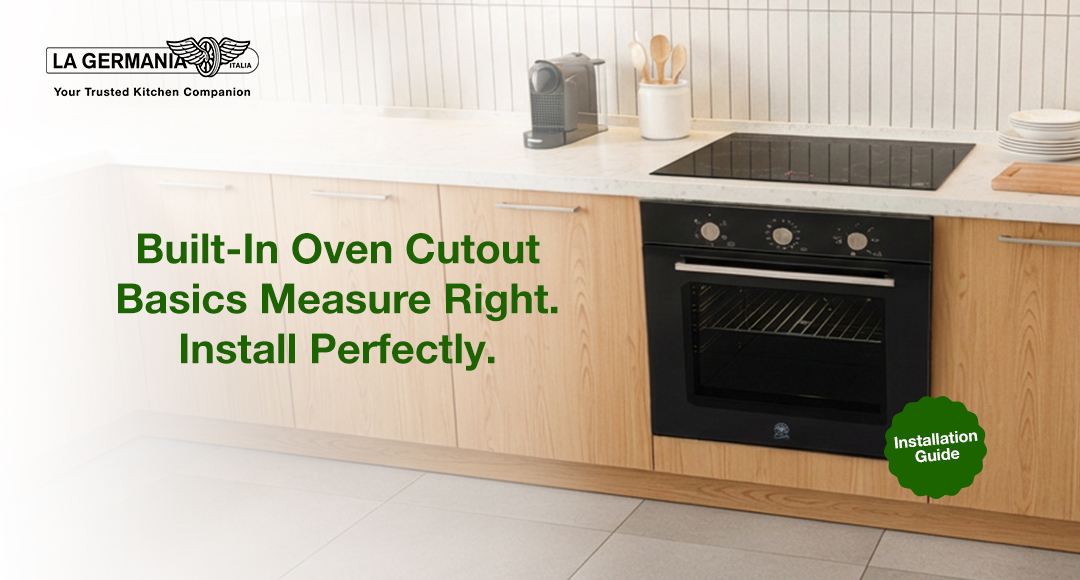
What “cutout size” really means
Every built in oven has an outer shell that slides into a cabinet opening. The cutout size is the opening that your carpenter cuts in the cabinet. It is not the same as the outside size of the cabinet itself, and it is not the same as the oven’s front frame. The front frame overlaps the edges of the opening to hide the gap and give a clean look.
There is also ventilation clearance. This is the small space around and behind the oven that lets cooling air flow. Cooling air matters because it protects the electronics and keeps the control panel from getting too hot. The manufacturer lists these gaps in the installation manual. Do not guess these numbers. Always follow the model’s manual.
Standard widths you will see in the Philippines
Most homes in the Philippines use 60 cm built in ovens. They fit standard modular cabinets and have enough room for family trays. If you cook party trays or want extra airflow for roasts and baking, you may choose a 90 cm built in oven. These need wider cabinet modules and a bit more planning for depth and ventilation. You can see current 60 cm and 90 cm built in ovens on the La Germania category page.
Where to find each model’s exact measurements
Open a model page and look for Additional information or Specifications. For example, the 60 cm F605 LAGEKX lists its dimensions in the Additional information section. The 90 cm FS969 LAGEKXT/18 also shows capacity and the door design. For a quick brand overview of 60 cm built in ovens, you can also read the “Guide to La Germania’s Best 60 cm Built In Ovens” on the Media section. These pages help you confirm size and features before you cut anything.
How to measure the cabinet opening the smart way
Use a tape measure in millimeters. Measure when the cabinet is empty and the floor is clear.
Start with width. Measure at the top, middle, and bottom of the opening. Write down the smallest number. Do the same for height at the left side, center, and right side. For depth, measure from the front edge to the back panel. If there is a socket box or a pipe on the back wall, measure up to that obstacle and note it. Small differences matter because oven shells fit tightly.
Check the front clearance. The oven door must open fully without hitting a wall or a nearby handle. If your base cabinets have thick handles, pretend to open the oven door and make sure they will not collide.
Plan service access. Electric models need a reachable junction box or outlet. Gas models need a reachable gas point. Make sure the oven body will not block these.
Leave ventilation space as written in the manual. Do not fill these gaps with foam or insulation. Those spaces are part of the cooling design.
Electrical and LPG planning before you cut
For electric ovens, many models need a dedicated circuit. Ask a licensed electrician to confirm breaker size and wire gauge for your chosen model. If you live in a condo, your building may have a total load limit per unit. It is easier to check this before you buy than after the cabinet is cut.
For gas ovens, follow the Department of Energy (Philippines) LPG safety guidance. Cylinders must stand upright in a ventilated spot. Do not place LPG cylinders inside sealed cabinets. Hoses and regulators must be in good condition and replaced on schedule. If your building has rules about LPG, clear them first. Department of Energy (Philippines)
Ventilation, cooling air, and cabinet materials
Built in ovens send warm air through slots and channels that you cannot see once the unit is installed. If you block these paths, the oven can overheat or shut down. Keep the gaps shown in the manual. Choose cabinet materials that handle heat and moisture well, like moisture-resistant boards and proper edge banding. Avoid thin vinyl edging close to the oven frame. Heat can loosen it over time.
Double glass oven doors and well-designed cooling fans help keep the outside cooler, but they still need airflow. You can confirm door and cavity notes on the model pages, such as the 60 cm F605 LAGEKGS and the 90 cm FS969 LAGEKXT/18.
The right sequence for a smooth installation
Pick your exact model first. Print or save its installation manual and product page.
Share the drawing with your carpenter and electrician or LPG installer. Ask them to mark the cutout on the actual cabinet. Do a dry fit with the oven still in its box to confirm the opening and screw points. Prepare the power or gas connection in the right place so it will not be blocked by the oven body. Slide the oven in and secure it with the screws from the manual. Do a test run with a simple dish so you can catch any issues early.
Common fit mistakes to avoid
Some homeowners cut the cabinet before choosing the model. This causes trouble because even a few millimeters can change the fit. Others forget ventilation space and wonder why the oven shuts down. In busy kitchens, the oven door sometimes hits a nearby handle on a drawer or a pantry; this is easy to miss in drawings but obvious in real life. Another mistake is placing the outlet or gas valve exactly where the back of the oven shell sits, which the installer then cannot reach. Study the product page and manual before you cut.
Real example: planning a 60 cm built in electric oven
Let us say you choose the 60 cm F605 LAGEKX. First, open the product page and note the listed dimensions. Then ask your carpenter to measure the cabinet opening at three points for width and height, and use the smallest numbers. Ask the electrician if a dedicated circuit is needed for this model and where the junction box should sit so it stays reachable. Confirm the ventilation gaps in the manual and mark them on the cabinet drawing. Do a dry fit and check that the oven door will not hit nearby handles or walls when open. After installation, preheat the oven and bake a small batch of cookies to confirm even heat and to burn off any light factory smell.
Real example: planning a 90 cm built in oven
Now, let us say you choose a 90 cm oven. If you like electric, check the FS969 LAGEKXT/18. If you prefer gas with fan assist, check the F980 LAGGKX. The 90 cm body needs a wider opening and strong support because it is heavier. Confirm that your floor or the shelf inside the tall cabinet can carry the weight. If your kitchen is a remodel, confirm countertop depth and side panels so the oven door opens cleanly. For gas, plan the cylinder location with ventilation in mind and follow the DOE LPG safety reminders. For electric, plan the dedicated circuit first, then cut the cabinet. Do a dry fit and test all functions.
Shortlist of La Germania models to reference while you plan
When you plan sizes, it helps to look at real product pages so you can match your cutout to a real unit.
- 60 cm electric built in ovens. Compare F605 LAGEKX, F605 LAGEKGN, and F605 LAGEKGS to see how finishes and specs differ, then pick the one that fits your kitchen look and budget.
- 90 cm ovens. If you want a large electric cavity, see FS969 LAGEKXT/18. If you want gas with fan assist for roasts, see F980 LAGGKX.
- Space-saving idea. If you have only one 60 cm slot and still want microwave plus baking in a single box, look at F45 LAGMWSXT or F38 LAGMWSXV 60, both in the Combi Microwave category.
You can also browse the entire Built in Ovens and Ovens categories, or jump to the Shop to see what is listed right now.
Cabinet depth, toe kicks, and door swing
Depth is easy to overlook. Many 60 cm ovens need a cabinet depth that allows a little space behind the oven body for wires or a gas point. If your base cabinet has a toe kick that sticks in too far, the oven may not slide in all the way. Mark depth on the cabinet sides and check the route of any hoses or cables. For door swing, make sure nearby tall pantry doors or fridge handles will not hit the oven door when it is open. A quick tape-and-cardboard mockup can save you a lot of rework.
Materials, heat, and moisture
Use board materials that resist heat and moisture near the oven. Seal edged parts that sit close to the oven frame. If you plan a tall unit with an oven stacked under a microwave or a combi unit, follow both manuals. Each product needs its own ventilation path. For combi microwaves like the F45 LAGMWSXT and F38 LAGMWSXV 60, the installation drawings show air paths for both the microwave and the grill or convection sections.
Simple tool kit and site prep
You do not need fancy tools to confirm a cutout. A tape measure, a spirit level, a carpenter’s square, and a pencil are enough to mark the lines. Clear the cabinet, remove any temporary shelves, and check that screws or brackets from old appliances are out of the way. If you are reusing a cabinet, make sure the sides are still square. An out-of-square opening makes the oven door look tilted even if the unit is installed correctly.
A printable checklist you can copy into your notes
Write down the model name and link, the external width, height, and depth, the opening width, height, and depth, the required ventilation gaps at the back and sides, the door swing space in front, the distance to nearby handles and walls, the position of the socket or junction box or gas valve, and any building rules about load or LPG. With this one page, your carpenter and installer can work in sync.
Internal links to help readers continue the journey
As you finalize the cutout, it helps to compare models and finishes side by side. You can browse Built in Ovens, see all Ovens in one page, check the Combi Microwave Ovens category if you need a do-it-all unit, or go straight to the Shop to view the latest listings.
External links for safety and planning
Use the DOE LPG Safety Tips if you are planning a gas oven so you can place the cylinder and route hoses correctly. These reminders help you avoid common mistakes in a tight kitchen
Frequently asked questions
What is the most common built in oven size in the Philippines
The 60 cm size is the most common because it fits standard cabinet modules and has enough capacity for family use. You will find several 60 cm models on La Germania’s built in category page.
How do I know the exact cutout for my model
Open the product page, check the Additional information or Specifications for dimensions, and download the installation manual. For example, the pages for F605 LAGEKX and FS969 LAGEKXT/18 show dimensions and design details that help you plan the opening and front clearance.
Can I install a built in oven in a condo
Many condos allow built in electric ovens if your total load stays within the unit’s limit and if the oven has a dedicated circuit. Confirm with your building administrator before you buy. For gas, some buildings restrict LPG inside units, so ask first and follow DOE safety tips if it is allowed.
What happens if I ignore ventilation clearance
If you block cooling airflow, the oven can overheat, shut down, or age faster. Always follow the manual’s gap sizes and keep vents open.
Is it okay to place the outlet or gas valve directly behind the oven
Place power points and gas valves where the installer can reach them after the oven is in place. Do not put them exactly where the oven shell will sit. This prevents service problems later.
What if my opening is a bit larger than the oven
Installers often use brand-supplied screws and brackets to secure the unit. The front frame of the oven hides a small gap. Never fill the ventilation space with foam or wood, because that space is part of the cooling path.
What if my kitchen is very small
If space is tight, consider a combi microwave that can bake, grill, and microwave in a single 60 cm slot, such as F45 LAGMWSXT or F38 LAGMWSXV 60. This approach keeps your layout simple while you decide on a full-size oven later.