

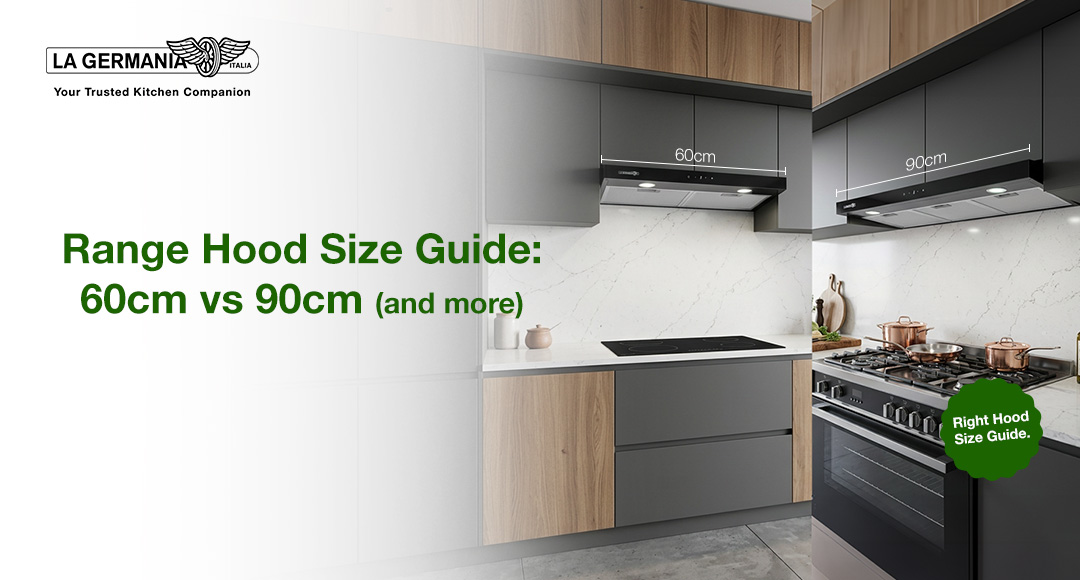
In the heart of every Filipino home, the kitchen is more than just a place to cook—and a range hood plays a vital role in keeping it clean and comfortable. It is where we sauté garlic and onions, fry crispy fish, and boil soups like Sinigang or Bulalo for many hours. Without a good way to clean the air, these smells can turn into sticky grease on your cabinets and leave a smoky haze in your living room.
Choosing the right range hood is the most important step in keeping your home fresh and easy to breathe in. Whether you live in a small condo in BGC or a large house in the province, you need to know which size fits your kitchen. This guide will help you choose between 60cm, 90cm, and 120cm models so your kitchen always stays fresh.
Why Range Hood Sizes Matter in a Filipino Household
In the Philippines, our cooking style is distinct. We rely heavily on “ginisa” (sautéing) with garlic, onions, and tomatoes, which releases a fine mist of oil and water vapor into the air. We also love deep-frying and high-heat searing. Without an adequately sized range hood, these particles settle on your furniture, walls, and even your ceiling, leading to “amag” (mold) or yellowish grease stains that are notoriously difficult to scrub off.
When we talk about range hood dimensions, we aren’t just talking about whether it looks good above your stove. We are talking about the “capture zone.” This is the physical area where the range hood can effectively trap steam and smoke before they escape into the rest of your home. If your range hood is too small, the steam simply curls around the edges and remains in your kitchen.
Matching Range Hood Width to Your Cooktop
The most basic rule of kitchen design is that your range hood should be at least as wide as your cooking surface. This ensures that the plume of smoke rising from any burner is caught by the filters.
Why Width Matters for Performance
As air rises, it expands. If you are boiling a large pot of pasta on a front burner, the steam doesn’t rise in a perfectly straight line; it fans out.
- For 50cm to 60cm Cooktops: A 60cm model is the standard requirement. This is the most common setup for apartments and starter homes.
- For 70cm to 80cm Cooktops: An 80cm or 90cm range hood is recommended to ensure full coverage, especially if you have a high-output burner located on the side.
- For 90cm Cooktops: A 90cm range hood is the minimum. However, in professional-grade Filipino kitchens where multiple large woks are used simultaneously, some homeowners opt for 120cm or even wider range hoods to account for cross-drafts from open windows or electric fans.
The Overhang Advantage
In many Filipino “dirty kitchens” or outdoor cooking areas, wind can interfere with your range hood’s efficiency. If space permits, choosing a range hood that is one size larger than your stove (for example, putting a 90cm range hood over a 60cm stove) provides a safety buffer. This “overhang” creates a larger reservoir for smoke to collect in before being sucked out by the motor, ensuring that even if a gust of wind blows, the smoke stays within the capture zone.
60cm Range Hoods: The Metro Manila Condo Standard
If you live in a modern high-rise condo in Makati, Ortigas, or BGC, you are likely working with a compact kitchen layout where every inch is precious. The 60cm width is the industry standard for these urban dwellings.
Best Uses for 60cm Range Hoods:
- Small Spaces: These are ideal for studio or one-bedroom units where the kitchen is often part of the living area. A 60cm range hood keeps the living room from smelling like dinner.
- Undermount Integration: For a minimalist aesthetic, undermount hoods are the way to go. They are installed beneath a kitchen cabinet, hiding the bulky machinery and providing more storage space for your spices and cookware.
- Standard Ranges: Most 4-burner cooking ranges in the Philippines are 50cm to 60cm wide. A 60cm La Germania range hood is specifically engineered to match these models in both size and airflow capacity.
80cm to 90cm Range Hoods: For the Modern Family Kitchen
As Filipino families grow and Sunday gatherings get bigger, so does the need for larger appliances. If you have moved up to a 5-burner gas range or a large 4-zone induction hob to accommodate bigger pots of Kare-Kare, a 60cm range hood will no longer be enough.
The 80cm Middle Ground
For kitchens that sit between compact and massive, an 80cm model offers a wider capture area without requiring the full footprint of a 90cm professional unit. This size is becoming increasingly popular in suburban house-and-lot developments where the kitchen islands are larger, but the owner still wants a streamlined look.
The 90cm Powerhouse
The 90cm range hood for kitchen setups is typically a chimney or wall-mount style.
- High Extraction Power: These units are designed for heavy-duty cooking. They often feature dual motors or reinforced fans with higher airflow rates to handle the intense heat and smoke of 5-burner stovetops.
- Design Statement: Beyond functionality, wall-mount hoods act as a visual centerpiece. In modern Filipino interior design, a stainless steel chimney hood reaching up to the ceiling signals a “chef’s kitchen” vibe.
If you are looking for the pinnacle of kitchen ventilation and style, the 90cm Wallmount Hood H33.9 is an ideal choice. This model combines a high-performance suction motor with a premium stainless steel finish, making it a favorite for Filipino homeowners who want to balance heavy-duty performance with a sleek, sophisticated aesthetic.
Understanding Depth and Installation Height of Range Hoods
While width is the primary concern for most buyers, the depth and the height of the installation are what determine whether the range hood actually works.
1. Depth and Cabinetry Alignment
A range hood should ideally cover the front burners of your stove. In many Philippine homes, custom cabinetry is built first, and then the range hood is bought later. Standard kitchen cabinets are usually 12 to 15 inches deep, but many gas ranges are 20 to 24 inches deep. If your range hood is too shallow, the smoke from the front burners (the ones we use the most!) will simply rise past the range hood and hit your face or the ceiling. Make sure your La Germania range hood model has enough depth to effectively cover your stove’s cooking area.
2. The Critical Height (Clearance) for Safety
Proper clearance is a matter of safety and machine longevity. In the Philippines, the standard height varies depending on your cooking technology:
- Gas Ranges: The range hood should be installed between 65cm and 75cm above the burners. If it is too low, the filters can catch fire from the open flame, or the heat can melt the internal plastic components. If it is too high, the suction loses its “tug,” and smoke will dissipate before reaching the fan.
- Induction Hobs: Since there is no open flame, you have more flexibility. You can install the range hood as low as 60cm. This is actually beneficial because induction cooking creates “heavy steam,” which needs to be caught quickly before it condenses back into water droplets on your kitchen backsplash.
Range Hood Performance Metrics: Beyond Physical Dimensions
A large range hood with a weak motor is just a very expensive kitchen ornament. When browsing for a range hood for your kitchen, you must look at the Air Capacity, measured in cubic meters per hour (m³/h).
Calculating Your Needs for Pinoy Cooking
Filipino cooking is uniquely demanding. We do a lot of “pag-gisa,” which releases heavy, aromatic oils.
- Light Cooking (Steaming/Boiling): If you mostly use your kitchen for cooking rice or steaming fish, a motor with 210 to 300 m³/h is sufficient.
- Heavy Cooking (Frying/Grilling): If you regularly fry Tuyo, cook Lechon Kawali, or grill meats indoors, look for a motor with 500 to 900 m³/h. This level of power ensures that the heavy oil molecules are filtered out, keeping your curtains and sofa from smelling like a carinderia.
Maintenance and Care for Long-Term Efficiency
A range hood is an investment in your home’s health. To keep it running efficiently in the humid Philippine climate, regular maintenance is a must.
- Clean the Filters Monthly: In the Philippines, humidity makes grease “sticky.” If you don’t clean your aluminum or stainless steel filters every few weeks, the grease will harden, blocking the airflow and making the motor work twice as hard.
- Carbon Filter Replacement: If you are using a “Ductless” or “Recirculating” range hood (common in condos), you have carbon filters that neutralize odors. These cannot be washed; they must be replaced every 4 to 6 months to keep your kitchen smelling fresh.
- Check the Ducting: If you have a ducted system, ensure the outside vent isn’t blocked by bird nests or debris, which can happen frequently in provincial areas.
Helping You Decide
Ready to find the perfect fit for your home? Explore the complete La Germania collection to find the ideal match for your cooking style. For compact kitchens, our undermount hoods offer the best space-saving solutions for 60cm layouts without compromising on suction power. For those with larger kitchens needing 90cm of professional-grade coverage, our premium wall-mount hoods provide a stunning visual centerpiece and high-performance air extraction.
Beyond ventilation, you can pair your new range hood with our signature heavy-duty cooking ranges to handle any family feast. If you prefer a more contemporary setup, we also offer modern, energy-efficient induction hobs that pair perfectly with our 60cm range hood models. For specific measurement concerns or to ensure your new appliance is set up correctly, feel free to contact us to speak with our technicians for professional installation and expert advice.
Frequently Asked Questions (FAQs)
Can I use a 60cm range hood with a 90cm stove?
It is strongly discouraged. A 60cm range hood simply does not have the physical width to capture the smoke plume from the outer burners of a 90cm stove. This leads to grease buildup on your cabinets and ceiling, eventually causing damage to your kitchen’s paint and woodwork.
What is the best range hood height to prevent “untog” (bumping your head) while cooking?
Ideally, the range hood should be 65cm to 75cm above the cooktop. If you are taller than average, consider a chimney design or an angled range hood. These models provide more forehead clearance while still maintaining the powerful suction needed to keep the air clean.
Do I need a bigger range hood for a gas range vs. induction?
While the width requirement should always match the cooktop, gas ranges produce significantly more ambient heat. This requires a range hood with higher temperature tolerance and a consistent airflow rate to manage the heat generated by the flames.
How do I know if my condo allows a ducted range hood?
Most modern condos in the Philippines, especially in Metro Manila, are designed for recirculating or ductless range hoods because the building structure does not allow an external vent hole. Always check your building’s “House Rules” or consult with the building administration before purchasing a ducted model to avoid installation issues.
Is stainless steel better than glass for Filipino kitchens?
Both materials have their merits. Stainless steel is incredibly durable and easy to wipe down after a session of heavy frying. Glass range hoods offer a more modern, airy look and are easy to clean with a simple glass cleaner, though they may show grease splatters more clearly than brushed metal.